


Let me tell you a story.
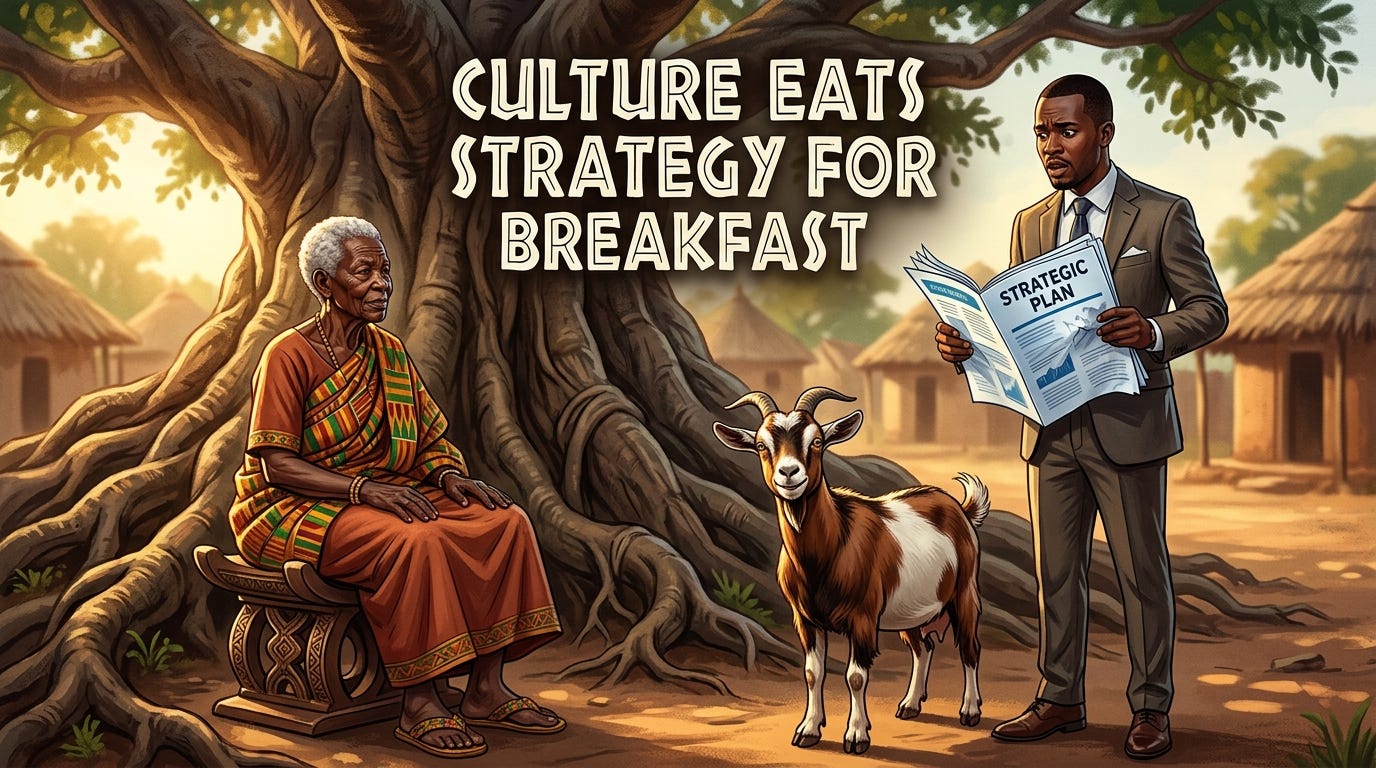
There was once a village that hired a brilliant strategist—a man who spoke in diagrams, wore glasses without lenses, and said things like “synergy” without flinching. He arrived with a 200-page development plan, printed on paper so glossy it reflected the sun like a warning.
The villagers gathered around him as he unfurled his masterpiece.
“This,” he declared, “is how we will transform the village.”
The plan had everything: timelines, KPIs, stakeholder matrices, even a section titled ‘Quick Wins’—which is consultant code for “things we hope work before people realize nothing else will.”
But then something strange happened.
The village elder—a quiet woman who had seen more failed plans than rainy seasons—asked a simple question:
“Before we follow your strategy, tell me… what do you think our culture is?”
The strategist smiled confidently.
“Oh, culture?” he said. “Culture is the soft stuff.”
The elder laughed so hard she nearly dropped her walking stick.
“Soft?” she said. “My son, culture is the thing that will chew your strategy, swallow it whole, and burp out your credentials.”
The villagers nodded. They had seen this before: outsiders bringing strategies that assumed people behave like spreadsheets—predictable, linear, obedient. But culture is not a spreadsheet. Culture is a living organism with teeth, memory, and a sense of humor.
The elder continued:
“Let me tell you a story. Once, a man tried to teach a goat to fetch water. He spent weeks training it. Charts, incentives, positive reinforcement. The goat learned nothing. One day, frustrated, he asked me why the goat refused to cooperate.”
She paused.
“I told him: Because goats don’t fetch water.”
The strategist blinked.
“That’s it?” he asked.
“That’s it,” she said. “You cannot strategize your way out of a cultural truth. And besides, my son—your plan is too expensive. This village cannot afford the cognitive rent.”
The strategist frowned. “The what?”
“The cognitive rent,” she said. “Every new idea that walks into a village has to pay rent before anyone will let it live here—rent paid in trust, in familiarity, in proof that it won’t get someone hurt for believing it too soon. Your plan arrived asking to move in for free. Nothing moves in for free. Not even a good idea.”
The villagers laughed—not at him, but at the eternal comedy of humans who think intelligence can overpower identity.
The strategist, to his credit, did not pack his bags. He stayed. He sat under the baobab tree, said very little, and listened for three moons.
One evening, he returned to the elder.
“I understand rent now,” he said. “But how do I pay it? I have money. I have data. What currency does culture accept?”
The elder tilted her head.
“Currency?” she said. “You don’t pay cognitive rent with money. You pay it with presence. You pay it by sitting in the dust until someone offers you water, not because you asked, but because you stayed long enough to become familiar. You pay it by letting your beautiful plan be torn apart and reassembled by the very people who will have to live inside it. Rent is paid in the currency of dignity—and dignity cannot be rushed.”
She leaned forward.
“You wanted to rewrite our operating system. But you arrived without knowing what operating system we were running. You assumed it was broken. You never asked if it was merely different.”
The strategist looked down at his beautiful plan—suddenly aware it was less a roadmap and more a menu item for a hungry cultural beast. He had not budgeted a single line for what it would actually cost to be believed.
He stayed another year.
In that year, he discovered that the village already had systems for resolving disputes, allocating water, and managing harvests. His plan wasn’t wrong—it was just alien. He stopped importing solutions and started translating aspirations. He asked the youth to teach him the local proverbs. He asked the elders to explain why certain decisions flowed through certain lineages. He stopped asking the goat to fetch water and watched, instead, how the goats actually moved—and realized they could pull a light cart if the yoke was carved to their shape.
His reforms took three years instead of six months. They moved slower, but they moved with the current, not against it. When the plan finally took root, it took root because the village co-authored every line.
Here is the prophecy.
Africa does not fail because it lacks strategy. Africa fails because it keeps importing apps for an operating system it never installed—and never once budgets for the rent that operating system charges before it lets anything new run.
You cannot run Scandinavian governance on a colonial-era incentive structure. You cannot run meritocracy inside a culture where proximity outranks performance. You cannot run accountability in a system where truth is treated like contraband.
Development plans collapse not because they are poorly written, but because they are culturally incompatible. It’s like trying to install Windows on a stone tablet. The tablet is not the problem. The assumption is.
But here is the nuance the first parable left out:
The operating system can be rewritten. But rewriting an OS while the system is live is the most dangerous, delicate work there is. You cannot shut down a culture for maintenance. You cannot push an update from a hotel conference room. You have to rewrite it incrementally, with backups, with consensus, with the elders and the youth holding the keyboard together. It takes a generation—not a fiscal quarter. And if your funders demand a six-month harvest, tell them that a six-month harvest is a famine. A generational harvest is a feast.
The goat will never fetch water. That is a biological fact. But the goat will pull a cart, if you treat it with patience and carve the yoke to its shoulders. The fields get watered, just slower, and with fewer broken buckets. The moral is not “don’t try.” The moral is “try the way the ground allows.”
So yes—culture eats strategy for breakfast.
But here is the secret the elder whispered to the strategist on his final morning in the village:
“Culture eats strategy for breakfast because culture is hungry for belonging, not for food. Feed it belonging, and it will stop eating your plans. It will start digesting them into something that actually runs.”
Culture doesn’t just eat strategy. It eats consultants, reforms, five-year plans, and any leader who thinks PowerPoints can defeat human nature—and it charges every single one of them rent on the way in, whether they ever notice the bill or not.
Culture is undefeated. Culture is heavyweight champion. Culture has never lost a fight—not even by split decision.
And until leaders stop treating culture as decoration and start treating it as infrastructure, every strategy will remain a beautifully formatted hallucination, evicted the moment nobody’s left in the room to keep paying its rent.
“Strategy is what leaders announce. Culture is what people do when no one is watching. But if leaders watch long enough—and pay the rent honestly—they might just discover that culture is not the enemy of strategy. It is the only engine strong enough to pull it forward. The goat will never fetch water. But it will pull the cart, if you let it be a goat.”
Let me hear from you. Subscribe if this made you uncomfortable — that’s usually the sign it was worth writing.
Oji - The Reciprocist.