

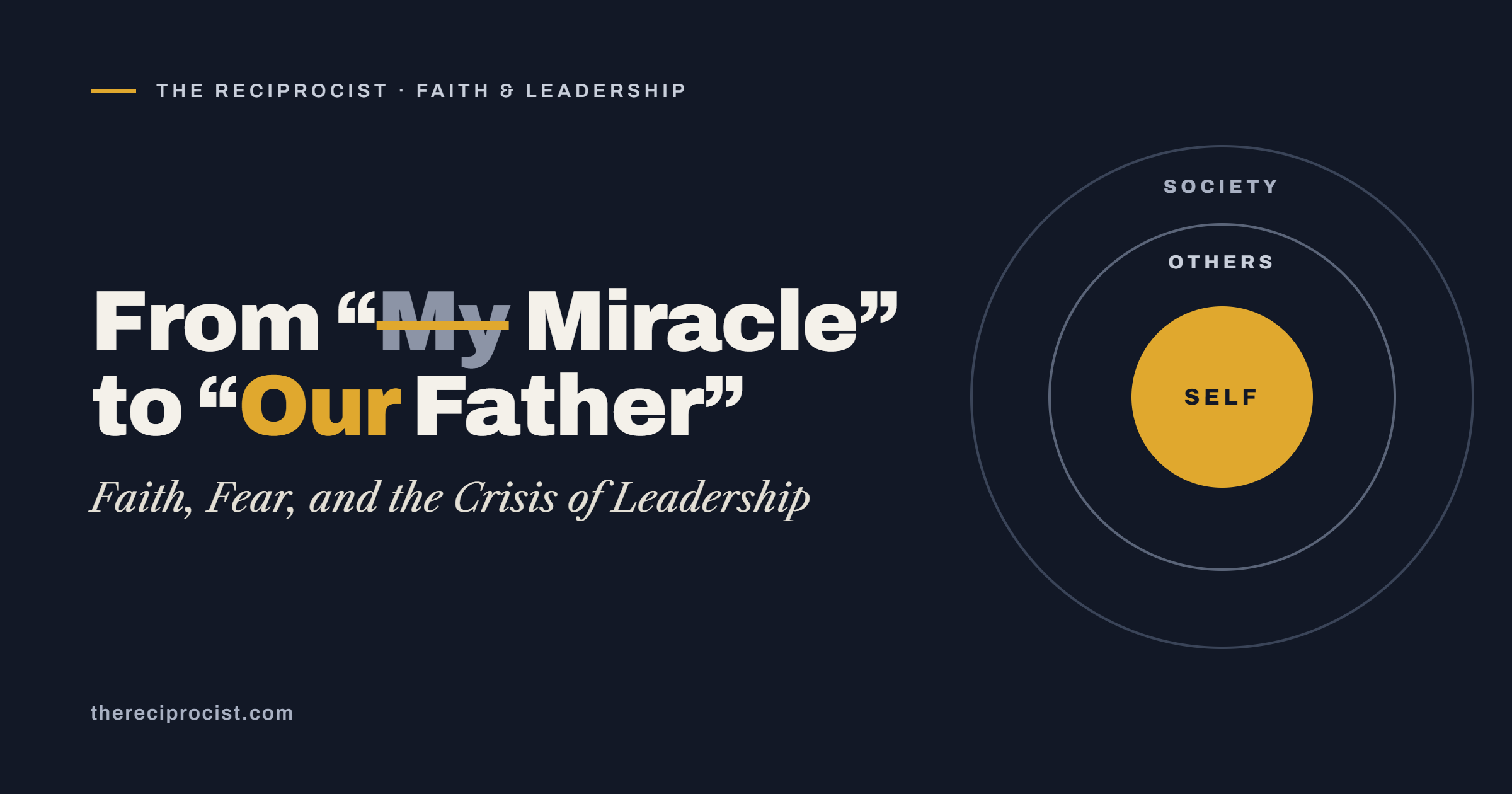
A reflection on leading ourselves, leading others, and leading a society that has stopped asking questions
I grew up in a small village, a farm boy, hearing a different grammar of faith. We prayed, “Our Father.” We asked, “Give us this day.” We confessed, “Forgive us.” The language was plural. It assumed that we stood before God together, that faith was a shared burden and a shared hope.
Now the grammar has changed. “My God.” “My destiny.” “My breakthrough.” “My seed.” “My miracle.” The congregation is no longer a body; it is a market of isolated individuals, each with a private fear and a private wallet. That shift is not cosmetic. It is the theology of a new religious economy—and it is making merchants rich while leaving the poor spiritually and financially exhausted.
It is also a crisis of leadership. Leadership, at every level, begins with grammar. A person who can only say “my” cannot lead anyone well, not even himself. A leader who says “our” has accepted responsibility for more than his own appetite. What has happened in too many pulpits is a collapse on three fronts at once: the leadership of self, the leadership of others, and the leadership of society. This essay is about all three, because the merchant-pastor can only thrive where all three have failed.
Let me be blunt: I am not attacking faith. I am attacking predation in the name of faith. I am not saying every church is a scam or every pastor is a predator. But in Nigeria and similar contexts, the pattern is too common to ignore. Too many pulpits have become checkout counters, and too many pastors have discovered that poverty, fear, and hope are the most reliable raw materials in the business of religion.
Poverty Is the Market
The first thing the modern merchant-pastor understands is that poverty is not just a condition; it is a market. In a country where hospitals fail, jobs vanish, schools decay, insecurity rises, and government often feels absent, a preacher who promises immediate cure for every human problem does not need to prove much. He only needs to be louder than despair.
Begin here, with the failure of societal leadership, because this is where the market is created. When those entrusted with public life abandon their duty, the vacuum does not stay empty. Someone fills it. When the state will not heal, the prophet promises to. When the economy will not employ, the altar promises to provide. The merchant-pastor did not create the despair; he learned to monetize it. Every leader who fails a hospital, a classroom, or a payroll is, knowingly or not, a supplier to the miracle economy.
And it is an economy. It sells certainty in an uncertain society. It sells “breakthrough” to people who cannot afford the next meal. It sells “deliverance” from enemies while the real enemy is a system that has abandoned them. It sells “first fruits” to a worker whose salary has not been paid.
It also sells “seed faith,” and on this one the farm taught me better. A seed is something you plant in your own soil. You clear the ground, you weed, you wait for rain, and if the harvest fails, you look at the soil, the season, and your own labour. No farmer plants his last seed in another man’s field and calls it a harvest strategy. Yet that is exactly what is asked of the widow who is told her last money is an investment in heaven.
And when the miracle does not come? The failure is never the preacher’s. It is your lack of faith. Your hidden sin. Your unpaid tithe. Your insufficient seed. There is no refund policy in the miracle business. There is no accountability. There is only another offering, another deliverance session, another “special programme.”
Fear Is the Currency
They do not begin with the God of love. They begin with the God of ambush. Your enemies are at the gate. Your village people are after you. Your generational curse is speaking. Your star is under attack. Your destiny is being caged. Your business is under a spell.
Fear opens wallets because fear is urgent. Hope can wait; fear cannot. The pastor becomes the only one who knows the code to disarm the curse, break the bondage, and release the blessing. That is not faith. That is captivity with a hymn.
This is where leadership of self is won or lost. A frightened person hands over the steering wheel. He stops reasoning and starts obeying. The first act of leading yourself is refusing to surrender your mind to whoever shouts loudest about your enemies. Self-leadership is not pride; it is stewardship. God gave you a conscience and a capacity to think, and outsourcing both to a man with a microphone is not humility. It is abdication.
What the fear sermon does is psychological manipulation dressed in scripture. It creates a crisis, then sells the solution. It makes you feel hunted so that the preacher can become your only refuge. It turns the sanctuary into an emergency room that charges admission and never discharges the patient.
Oratory Is the Sales Funnel
Let us be honest: many of these men are gifted. They can switch tongues, rhythm, pause, whisper, and thunder. They can make a congregation laugh, then weep, then open their bags. They can read your clothes, your anxiety, your posture, and call it revelation. They can tell you God spoke to them about you—and because they are fluent, confident, and theatrical, you believe them.
Oratory is not the problem. Oratory without accountability is. The pulpit becomes a stage. The sermon becomes a sales pitch. The altar call becomes a closing technique. They use repetition, story, prophecy, shame, and crowd contagion. They create a sense of urgency: “Tonight is your night.” “If you miss this seed, you miss your season.” “The enemy is angry because your breakthrough is close.”
Here is a lesson for anyone who leads others—in a church, a company, a ministry, a government office, or a home. Influence is not the same as leadership. The ability to move a crowd is a power; what you move them toward is the test. A leader spends his gifts on the people in front of him. A merchant spends the people in front of him on himself. The same voice that could teach a congregation to think is being used to teach it to pay.
This is not preaching. This is salesmanship with Bible verses. The microphone is the funnel, the crowd is the market, and the offering basket is the till.
The Psychology of the Altar
The tactics are familiar to anyone who has watched spiritual abuse up close. Love-bombing when you arrive. Public shaming when you doubt. Isolation from critics. “Touch not my anointed.” Spiritual fatherhood used as control. Deliverance cycles that never end because the diagnosis is always another demon. Testimonies that only show the successes and never the ruined lives left behind.
Questioning the pastor becomes rebellion against God. Leaving the church becomes backsliding. Giving less becomes a lack of faith. The system turns shame into revenue and hope into a subscription. You are always guilty; the preacher is always the judge—and he is always willing to offer you a discount on your own liberation.
Notice what all of these have in common: they are ways of escaping accountability. That is the signature of failed leadership anywhere. Healthy leaders invite questions, publish their accounts, and let people leave without curses. A leader who treats every question as rebellion is admitting that his authority cannot survive scrutiny. The same is true in a boardroom, a political party, or a family. Wherever “don’t question me” replaces “here is why,” leadership has turned into control.

The Christ They Never Preach
The irony is that Jesus never founded a denomination or built a franchise. He healed people and said, “Your faith has made you whole.” He did not charge for miracles. He did not turn the temple into a VIP section; he overturned the tables of those who did. He did not sell “first fruits” for a private jet. He did not use fear to fund his ministry.
His life is also the clearest picture of leadership on all three levels. He withdrew to quiet places to pray—leading himself before he led anyone else. He knelt and washed his disciples’ feet, and told them the greatest among them must be their servant—leading others by serving them. He walked into the temple and confronted a system that profited from the poor—leading society by naming what others would not.
Yet many who claim his name preach a Christ who is a mascot for their business model—a Jesus who wants you rich but not free, blessed but not discerning, giving but not thinking. That is not the gospel. It is a franchise.
Leadership Begins in the Pew
It is easy to blame the merchants and stop there. But a market only exists because there are buyers, and the way out runs through each of us. Leadership is not a title reserved for the man on the stage. It is a responsibility that begins in the pew.
Lead yourself. Read for yourself. Test every prophecy against scripture and against reality. Give from conviction, not from fear, and never give what your family needs to eat. If a message makes you feel hunted, ask who benefits from your fear. Your discernment is not disloyalty to God; it is obedience to the mind He gave you.
Lead others. Someone is watching how you practise your faith—your children, your siblings, your colleagues, your friends. Teach them that questions are welcome in the house of God. Support the honest pastors, and there are many, who preach without manipulation and account for every naira. Ask, respectfully and publicly, for financial transparency in your own congregation. Silence is how predation is protected.
Lead society. The miracle economy grows wherever institutions fail, so the long answer is not only better sermons; it is better public leadership. Demand that hospitals heal, that schools teach, that salaries are paid, so that desperation stops being the church’s most reliable revenue stream. Build the “our” again—in cooperatives, in community associations, in neighbours who help one another without needing a stage. Every time a community solves its own problem, a merchant loses a customer.
A Religiosity of Discernment
What we need is not a religiosity of ignorance. We need a religiosity of discernment. Ask questions. Demand transparency. Reject fear-based giving. Test prophecy. Stop equating oratory with anointing. Stop equating wealth with righteousness. Stop treating the pastor’s microphone as the voice of God.
The gospel is not a business plan. The pulpit is not a checkout counter. God is not a lottery. And the poor are not seed money for another man’s empire.
Until we say that plainly, the merchants will keep selling hope, and the poor will keep paying for it. And until we recover the old grammar—our Father, our community, our responsibility—we will keep producing followers who cannot lead themselves, leaders who will not serve others, and a society that leaves its most desperate people to the highest bidder.
I would genuinely like to hear from you on that one.
Do subscribe, share.
OJI - Thereciprocist