

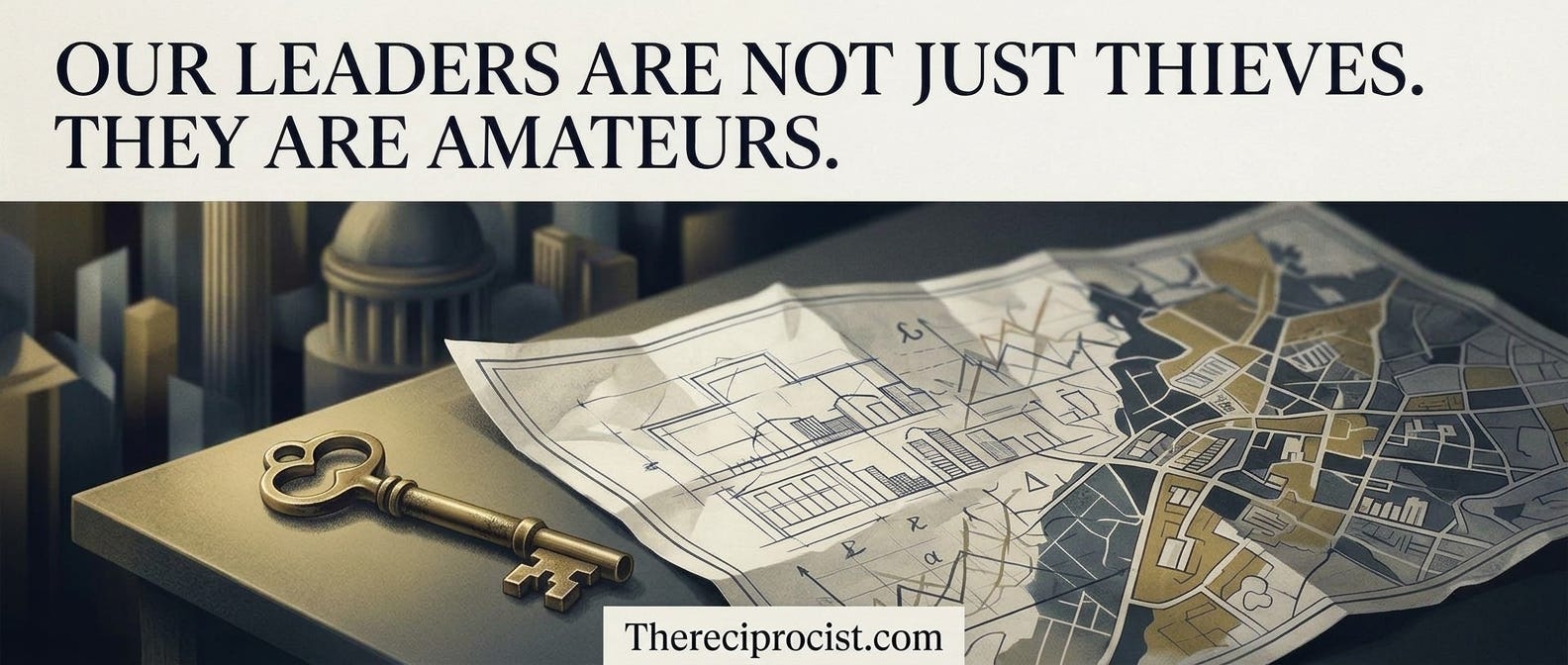
A while ago, in “Our Assumptions May Have Been Wrong All Along,” here is the link - https://tinyurl.com/3p6fcrxx
I argued that many of our corrupt leaders may be skill-less rather than simply greedy. Some of you pushed back, and fairly. So here is the sharper version, and I will not be gentle with it.
We have a comfortable explanation for corruption, and it fits on a bumper sticker: greed. Bad men. Weak character. Sticky fingers. End of analysis.
It is a satisfying story because it flatters everyone who tells it. It makes corruption a problem of those people—out there, identifiable, removable. Elect better men, and the problem goes away. We have been electing better men for generations. In Nigeria, we have been doing it since 1960. The problem has not gone away.
Greed is real. I am not here to argue otherwise. But greed explains the motive, not the pattern. Greed does not explain why so much stolen money sits in foreign accounts doing absolutely nothing—no factory, no farm, no fund, no return. Greed does not explain why a road that was fully funded is half-built, or why a power plant that was commissioned and photographed was never switched on.
A greedy man with a plan builds the road and skims off the top. A man without a plan takes the money and stares at it.
Which brings me to an uncomfortable suggestion—uncomfortable for them, and for us: many of the people we call corrupt are not criminal masterminds. They are out of their depth. They are not villains who chose wrong. They are amateurs who never learned how to do right—and who then discovered that stealing is considerably easier than learning.
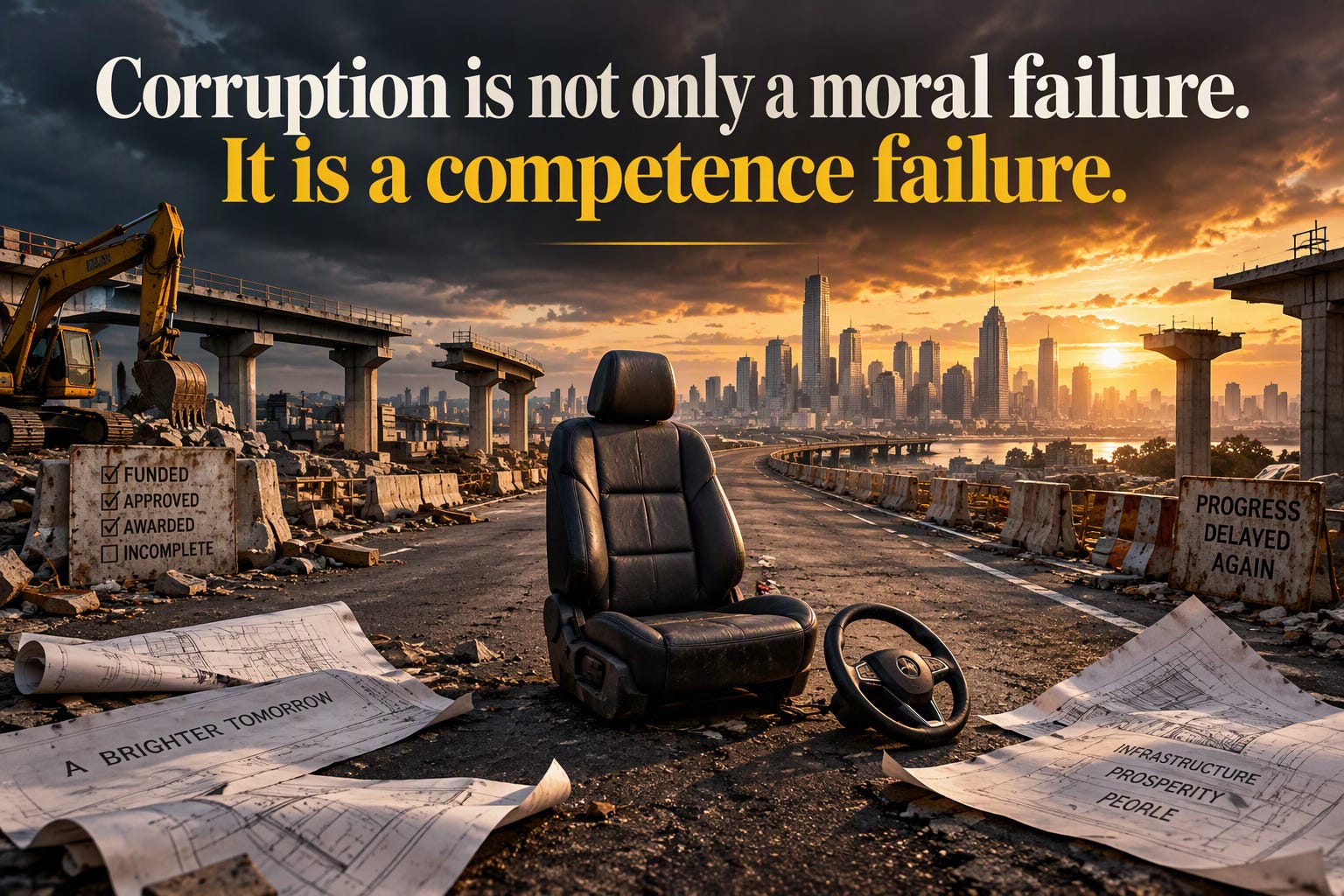
We have been flattering them by calling them masterminds.
What “skill-less” actually means
Let me be clear about what I mean, because this is where I expect to lose some of you.
I am not saying corrupt leaders are stupid. Plenty of them are sharp—sharp enough to win elections, sharp enough to survive audits, sharp enough to keep a straight face through a press conference. Cunning is not competence. What they lack is functional skill: the ability to put the right people in the right seats, to sequence decisions, to weigh a trade-off, to say out loud, “I do not know this—bring me someone who does.”
Three gaps show up again and again.
Managerial. They cannot run an organization. They can run a network—of loyalists, of debtors, of cousins. Those are not the same thing, and the difference announces itself the day something actually has to be built. And ego makes it worse: a man who cannot admit what he does not know will never send for the person who does. He would rather fail in charge than succeed with help.
Investment. They do not know how to deploy capital productively. Money, to them, is not a tool; it is a trophy. Hence the foreign accounts, the idle deposits, the curious spectacle of a man with billions and no portfolio, no enterprise, no legacy—just a large number in a bank he has never visited.
Strategic. They cannot prioritize. Everything is urgent, nothing is sequenced, and the country lurches from announcement to announcement like a man who has never read a map but keeps buying cars.
Now the analogy—and I will state it more carefully than I did the first time.
A skilled electrician can wire a building to burn. Skill does not make a man good; history is full of competent thieves. But a skilled electrician does not burn a building by accident. Competence does not guarantee integrity—it guarantees that failure, when it comes, is chosen rather than stumbled into.
That is the distinction I want to press. Corrupt leaders fail twice over. They do wrong, and they do it badly. They steal the money and they waste it. A competent crook leaves a road behind. An incompetent one leaves a hole, a fence, and a plaque.
Ask yourself which kind we have been getting.
When a product is assembled correctly, there are no missing screws. There may be extras—the manufacturer throws them in for the careless. There are never shortages. So when a project is fully funded and still comes up short—short of concrete, short of cable, short of completion—do not tell me the only missing ingredient was honesty. Something else was missing too.
The pattern is the evidence
I will not belabor Nigeria’s scandal sheet—you know it as well as I do, and the details change with every administration. But look at the shape of it, because the shape repeats with a predictability that ought to embarrass us.
A project is announced. Funds are appropriated—generously, publicly, with photographs. Contractors are paid. Then: a foundation, a fence, a signboard bearing the name of a dignitary, and silence. Years pass. The money is traced to accounts in cities the minister has never seen. A commission is formed. A report is written. Another project is announced.
We have seen this film so many times that we can recite the dialogue.
If this were pure greed, we would expect smarter greed. Greed at scale wants a return. What we observe instead is theft followed by paralysis—money pulled out of circulation and parked, projects abandoned mid-gesture, institutions hollowed out and not replaced. That is not the signature of a cunning elite. It is the signature of people who knew how to take and had no idea what to do next. They got what they wanted and discovered they had no use for it.
Money is a tool—a means to an end, never the end itself. We have not yet invented edible currency. I have never seen a comfortable bed made of dead presidents. You can exchange them for the bed; that much I grant you. But you cannot sleep on the exchange rate. Hoarding is not wealth management. It is a confession.
Yes, wealthy criminals in developed countries also stash money abroad. But look at what they are doing: evading tax, protecting a fortune earned in functioning markets, keeping capital intact because they understand what capital is for. The difference is often less virtue than competence. One man hides money because he knows how to make more of it. The other hides it because he would not know where to begin.
Before you accuse me of letting them off
Here is the objection, and it is a fair one: skilled people can be corrupt. So why blame incompetence?
Because I am not offering an alibi. I am offering a diagnosis, and the two are not the same. Incompetent leaders remain fully responsible for the harm they cause. A man who never learned to drive and crashes into your house is still responsible for the damage.
But hold two ideas at once. Corruption is a moral failure—yes. And it is frequently a competence failure—also yes. If we insist on the first and ignore the second, we will keep prescribing the same medicine: more prosecutions, more commissions, more headlines—and then a fresh set of amateurs with the same gaps and the same appetites. You cannot audit your way to competence. You cannot prosecute a country into capability.
So what do we do with this?
If the diagnosis is even partly right, the remedy has to be bigger than punishment.
It has to include selection. Who do we put in these chairs—people who can run things, or people who can win things? We interview a cashier more carefully than we vet a minister.
It has to include training, and the institutional patience to build it: civil services that know how to plan, managers who have actually managed, a bench of people who have done the job before they are handed the ministry.
And it has to include a culture in which a leader can say, without shame, “I do not know this; bring me someone who does.” That sentence is not weakness. It is the beginning of every functioning government on earth.
You cannot botch what you genuinely know how to do well. Which means the question was never only how do we punish the thieves? It is also why do we keep handing the keys to people who cannot drive?
And here is the harder question, the one that is about us, not them: why do we keep cheering when they take the wheel?
I would genuinely like to hear from you on that one.
Do subscribe, share.
OJI - Thereciprocist