


Every time someone says Africa has “abundant potential,” a part of me goes quiet.
Not offended — just unconvinced.
Because “abundant potential” is what people say when they haven’t done the work of naming anything real.
Potential is not a compliment.
It’s an unfinished sentence.
And Africa has lived inside unfinished sentences for too long.
We talk about promise, vibrancy, youth, creativity — all the warm adjectives that make panel discussions feel hopeful — but none of them answer the only questions that matter:
Where?
When?
Which sectors?
Without those three coordinates, “abundant potential” becomes a lullaby — a soothing phrase that helps outsiders feel optimistic and insiders feel patient. But optimism is not a strategy, and patience is not a plan.
If we are serious, then specificity is the price of entry.
Where is the potential concentrated?
Not “Africa.” Not “Nigeria.”
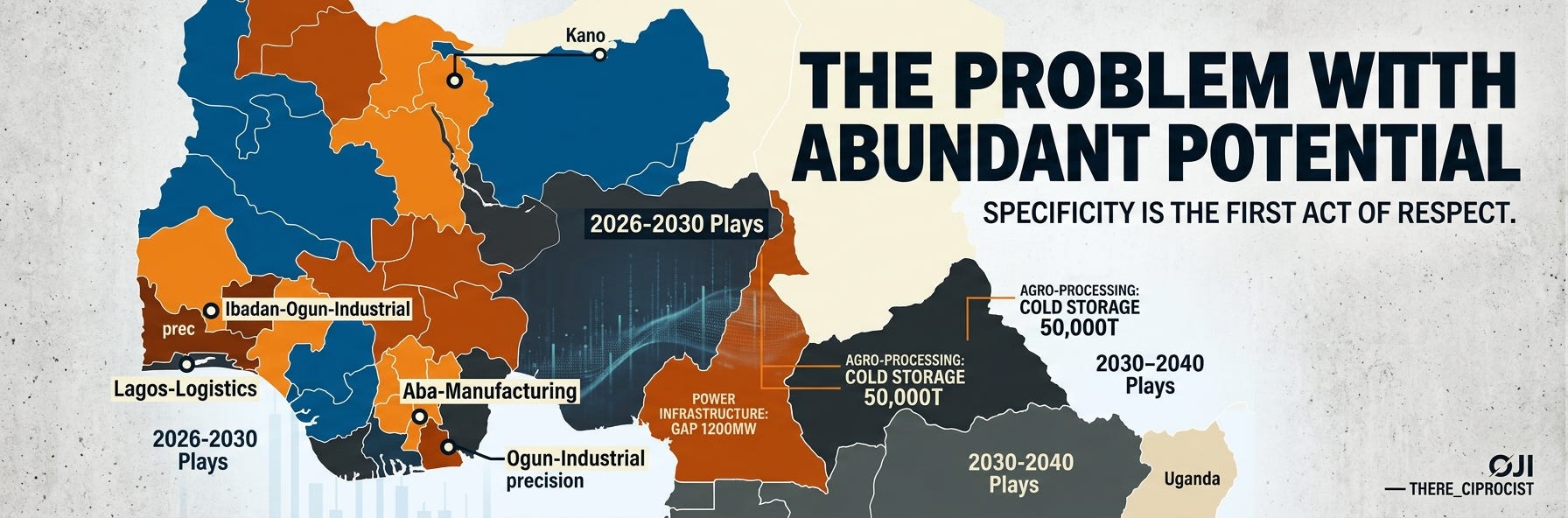
But Lagos logistics corridors, Aba manufacturing clusters, Kano agro‑processing belts, Ibadan–Ogun industrial spines.
Potential is geographic before it becomes economic.
When will the potential materialize?
Some opportunities are 2026–2030 plays — mobility, SME digitization, payment infrastructure.
Others are 2030–2040 plays — energy transition, manufacturing substitution, regional supply chains.
Potential has a timeline, not a vibe.
Which sectors actually have catalytic leverage?
Not “everything.”
Not “the youth.”
Not “creativity.”
But power infrastructure, agro‑processing, logistics, digital tooling, manufacturing, talent export pipelines.
Potential is sectoral before it becomes national.
The Reciprocist view is simple:
If you cannot name the coordinates of potential, you are not talking about development — you are talking about hope.
Hope is beautiful.
But hope is not a blueprint.
Africa does not need more praise.
It needs precision.
It needs people willing to stop romanticizing the continent and start mapping it.
Potential is not abundant.
Potential is specific.
And specificity is the first act of respect.
But respect, if we are honest, is not the end of the work. It is the beginning of a fight.
Because even a mapped location is just a dot on a page until you measure the gap.
How much?
What is the megawatt shortfall at that specific substation? What is the tonnage of maize rotting in that specific silo while the same market imports what it could have grown? Potential is not located — it is quantified. If you cannot tell me the deficit, you are still drawing pictures, not building systems.
Against whom?
And let’s not pretend these maps are empty. They are occupied. Customs cartels own the port corridors. Transport unions hold truck fleets hostage to unofficial tolls. Local incumbents have built generational wealth on friction — on the opacity that lets them skim, delay, and extort. Specificity is not a neutral planning tool. It is a declaration of war against everyone who profits from the chaos. Name them. Or admit you are too afraid to.
With what?
You want a timeline? Fine. Let’s talk about the cost of the money that buys that timeline. A 2030 horizon is a fairytale when local-currency financing costs 26% and hedging against the dollar eats another 15% before a single shovel breaks ground. Potential does not materialize because the year arrives. It materializes because the capital stack is structured to allow it. Name the instruments. Name the guarantees. Name the off-take agreements. If you cannot, your “timeline” is just a date on a calendar — not a plan, not a commitment, just a placeholder for your own procrastination.
Across what borders?
And stop cowering inside colonial lines. The Guinean bauxite does not care about the line on a map before it feeds a Ghanaian smelter. Nigerian gas does not stop at the border to power Benin’s grid. The catalytic leverage is in the corridors that break these drawn lines apart. If your “Where” stops at a country code, you are thinking like a colonial administrator, not a builder. You are fragmenting scale to make it manageable for PowerPoint, not for production.
Now, let me grant you one narrow, ugly use for vague hope.
It works as a hook. A headline. A way to get the cheque-writers and sovereign funds into the room. I am not naive enough to pretend otherwise. But that hook has an expiry date. If you utter “abundant potential” in a Q1 boardroom, you have until Q4 to produce your proprietary coordinates — your mapped corridors, your costed gaps, your named incumbents, your instrument-by-instrument capital plan. After that, you are not investing. You are not developing. You are just stealing time from people who do not have time to steal.
Because here is the bitter truth the panel discussions will never touch, the one that makes the moderators shift in their chairs:
“Abundant potential” is not a development diagnosis.
It is a luxury good.
Bottled and sold to those who can afford to wait, and force-fed to those who cannot. Consumed by the Global North as a soothing tonic for their consciences, and exported to the Global South as a substitute for hard capital, hard policy, and harder choices.
Africa does not need your adjectives.
It needs your balance sheets, your supply-chain redlines, your construction timelines, your customs overhauls, your transmission lines, your cold storage tonnage, your named beneficiaries, and your signature on the dotted line with a penalty clause attached.
If you cannot give me that, keep your “potential.”
And keep your silence while you are at it.
Subscribe and follow if this made you think differently — that’s usually the sign it was worth writing.
OJI - Thereciprocist