


By OJI — The Reciprocist
Civilization doesn’t survive on goodwill. It survives on behavior architecture. Leave a human being entirely to their own impulses and they will, with real creativity, stretch, bend, or quietly dismantle any system you put in front of them — not because people are villains, but because human nature is exploratory, opportunistic, and frankly a little bit feral. Give a man a rope and he will test its weight limit for you, free of charge, without being asked.
This is why leadership exists.
Leadership isn’t inspiration. It isn’t charisma, and it definitely isn’t a “vision statement” in a glossy brochure nobody reads past page two. Leadership is response-ability — a word I’ve used before on this newsletter and I’m not done using it — the capacity to anticipate how people will actually behave, design structures that guide that behavior, and enforce standards that keep the whole thing functional. Every society that’s actually thriving is run by leaders who understand one uncomfortable truth:
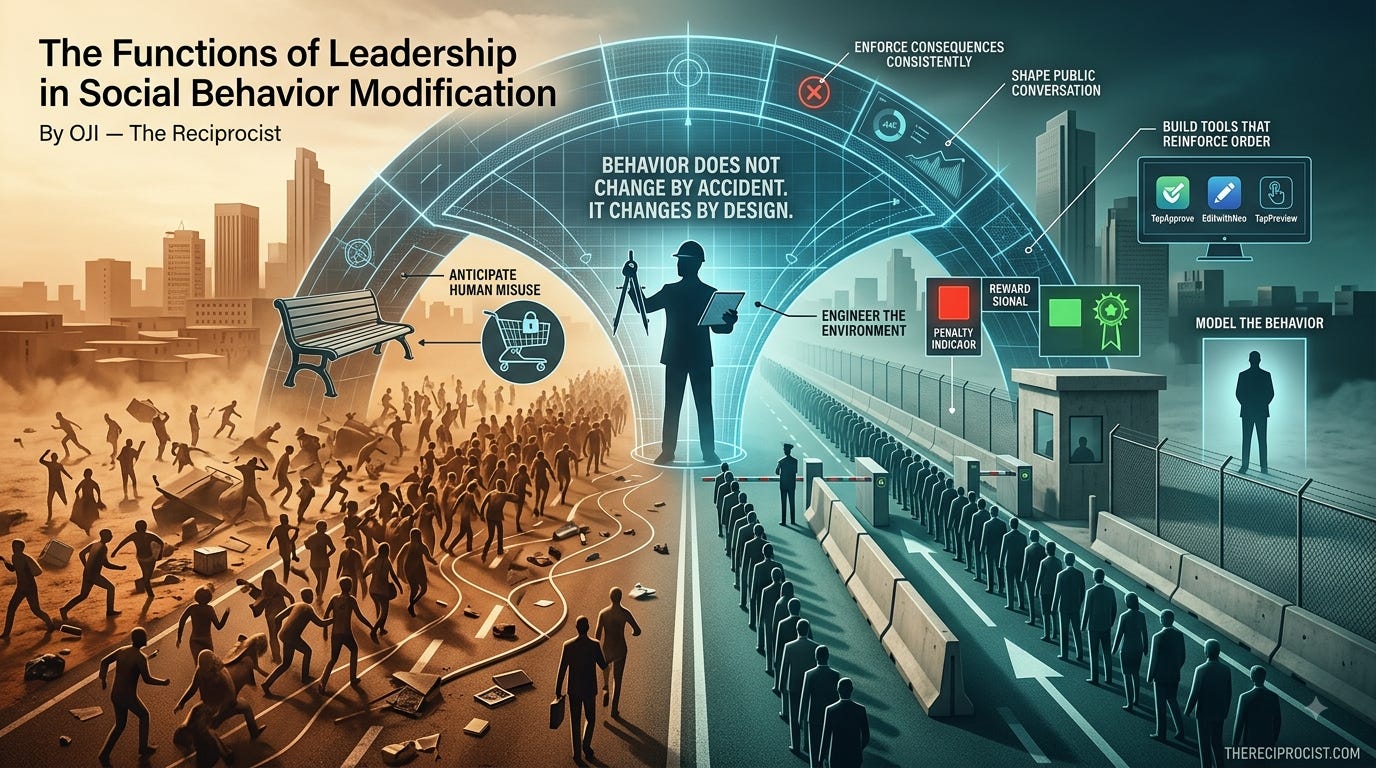
Behavior does not change by accident. It changes by design.
Here are the core functions of leadership in shaping — and modifying — how a society behaves.
1. Leadership Must Anticipate Human Misuse
If something can be misused, someone is already working on it. If something can be broken, consider it broken. If a loophole exists, somebody has already climbed through it wearing a suit, and somebody else is right behind them in flip-flops.
Effective leadership starts by assuming this, not being shocked by it.
Ever notice grocery carts that lock their own wheels the second you roll them past the parking lot line? That’s not paranoia. That’s a designer who sat down, thought about human nature for exactly four seconds, and built the correction into the cart itself instead of hiring someone to stand in the lot and yell.
Same logic, higher stakes: the bench at a bus stop in most developed cities is intentionally uncomfortable. Not cruelty — foresight. A comfortable bench becomes a bed. A bed becomes shelter. Shelter becomes a settlement nobody planned or budgeted for. The actual problem was never the person who needed to sleep. The problem was a designer who didn’t think two steps ahead.
Leadership anticipates misuse and builds systems that shrug it off before it starts.
2. Leadership Must Engineer the Environment
Social engineering gets a bad reputation it doesn’t fully deserve. Done right, it isn’t manipulation — it’s civilization management.
Barriers. Fences. Narrow pathways. Choke points with someone actually watching them. None of that is oppression dressed up in concrete. It’s order, wearing its work clothes. When movement is structured, behavior gets predictable. When behavior is predictable, a society becomes governable instead of merely hopeful.
This is why functioning societies quietly rely on:
uncomfortable benches
barbed wire in the places that actually need it
higher fences around anything sensitive
monitored crossings
pathways that only go where they’re supposed to
None of that is decoration. It’s behavior, poured in concrete.
3. Leadership Must Enforce Consequences Consistently
Behavior modification runs on one unglamorous fuel: predictable consequences.
Idiagbon proved it during the War Against Indiscipline. Under the Buhari/Idiagbon military government in Nigeria, Nigerians formed orderly queues almost overnight — not because a switch flipped in the national character, but because the system rewarded standing in line and punished cutting it. Candy or cane. The incentive was obvious, and — this is the part people skip — the consequence never wavered. That consistency did more civic education in a few months than a decade of “please be more orderly” posters ever managed.
Leadership has to build systems where good behavior is rewarded, bad behavior is discouraged, and enforcement is visible enough that everyone, not just the unlucky ones who get caught, actually believes it’s real.
Without consequences, rules are just suggestions with better fonts.
4. Leadership Must Shape Public Conversation
Commentators love a symptom. Corruption, disorder, inefficiency — great headlines, mediocre analysis. Nobody clicks on “structural design flaw identified,” even though that’s usually the actual story.
Leadership has to drag public conversation somewhere more useful:
What design flaw let this happen in the first place?
What environmental change would make it structurally harder to repeat?
What incentive is missing that would make the right behavior the easy behavior?
When public discourse graduates from outrage to actual solution architecture, a society starts acting like an adult.
5. Leadership Must Build Tools That Reinforce Order
Modern leadership isn’t only policy. Increasingly, it’s infrastructure — the kind you can actually click on.
Digital tools reinforce the same principles offline leadership relies on: clarity, trust, accountability. This is exactly the gap TapApprove.com, EditwithNeo.com, and TapPreview.com were built to close — transparent approvals, precision writing, credible previews. Not conveniences. Behavioral stabilizers. They reduce friction, raise trust, and make workflows predictable — which is the exact foundation every orderly system, digital or civic, is quietly built on.
6. Leadership Must Model the Behavior It Expects
People copy what they watch, not what they’re told. Nobody has ever been lectured into discipline by someone who visibly doesn’t have any.
When leaders show up disciplined, clear, and structurally minded, that behavior gets absorbed downstream, often without anyone noticing it happening. When leaders behave recklessly, the whole system learns that recklessness is apparently the actual policy.
Leadership is a mirror. The public just reflects back whatever’s standing in front of it.
7. Leadership Must Institutionalize Behavior Over Time
Behavior modification isn’t a launch event. It’s a cultural installation, and installations need maintenance.
Systems have to be documented, repeated, reinforced, updated, and protected — in that order, and continuously, because the moment you stop tending a system, human nature quietly starts renovating it without a permit.
When behavior becomes institutional, it becomes tradition. When tradition becomes identity, a society finally becomes stable. Leadership is the architect of that whole staircase.
Conclusion: Leadership Is Behavioral Engineering
Society isn’t held together by hope. It’s held together by design, incentives, consequences, communication, tools, and culture. Leadership is the architect of all six, whether or not it ever gets credit for the blueprint.
When leaders understand that their actual job is behavior modification, they stop reacting to chaos and start preventing it. They stop complaining about human nature and start designing for it — the way you’d design a bench, or a queue, or a grocery cartwheel, for the humans you actually have instead of the well-behaved ones you wish you’d been issued.
This is the leadership Africa needs. This is the leadership Nigeria deserves. This is the leadership that builds nations.
Let me hear from you.
TheReciprocist.com
OJI