


Alrayiith! We’re here again for this week’s narration. Let’s dig in, folks
Once, there was a village clawing at the edge of a desert. The rains had stopped. The children’s lips were cracked white, and the elders spoke of the old rivers with the reverence of ghosts.
Two men stepped forward to lead.
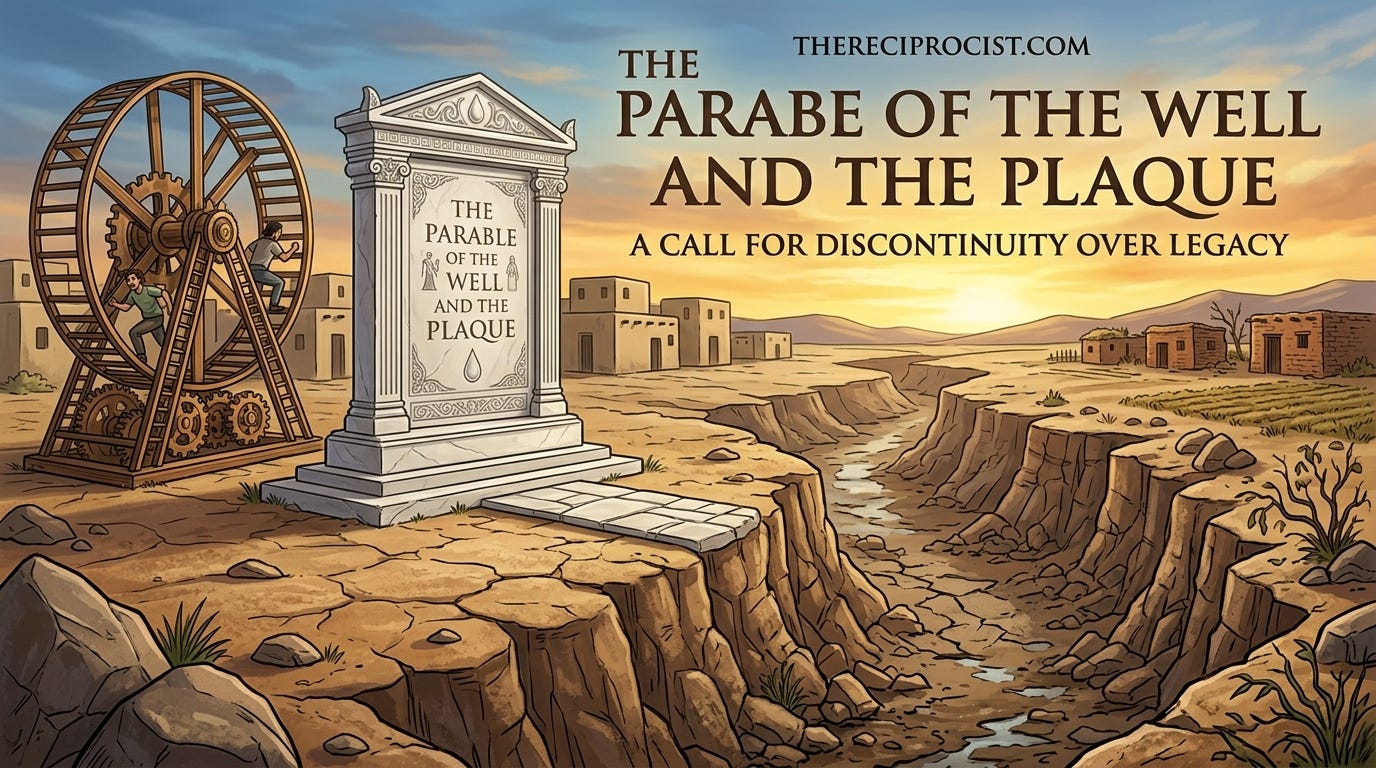
The First Man was a genius of theater. He climbed the highest rock, raised his arms to the scorching sun, and declared a “Race for Water.” He commissioned artists to carve his face into the mountainside. He wrote poems about the glory of the coming deluge. He held town meetings where he spoke of HISTORY—how his generation would be remembered as the saviors. He built a magnificent marble plaque at the center of the square, polished it daily, and etched upon it: “Here Stood the One Who Brought Life.” The villagers cheered. They danced around the plaque. They felt seen.
The Second Man said nothing. He woke at 4 AM while the village was asleep. He took a rusted shovel, walked to the dry riverbed, and started digging. He blistered his hands. His back screamed. He dug through rock, through clay, through the corpses of dead trees. He found a trickle. He dug deeper until the trickle became a muddy, unglamorous stream. He dug a canal—ugly, crooked, and lined with weeds—that fed the village fields.
When the First Man saw the Second Man’s muddy hands, he laughed. “Look at him,” he shouted. “No vision. No flair. No legacy!”
The village gave the First Man a crown. They threw festivals for his speeches. They named their children after him.
Then the dry season hit. Harder than before.
The First Man’s plaque stood pristine. His carved face stared down, arrogant and eternal. But there was no water in his words.
The Second Man’s canal, however, was still flowing. Muddy, ungrateful, and utterly ignored—but it saved the calves, the crops, and the crying infants.
Years later, the First Man’s statue was toppled by termites and forgotten. The Second Man’s name was forgotten too—but his great-grandchildren drank from his canal, never knowing his name, never needing to.
That is the Race of the Continent.
We are drowning in First Men. We are suffocating in the industrial manufacturing of HISTORY. We have turned leadership into a casting call for a bad epic. We polish plaques while our roots rot. We give standing ovations to orators who have never blistered a palm, and we call stagnation “stability” because the man at the podium has a deep voice and a silver tongue.
We are running. God, we are running. Sweat pours down our faces. Our lungs are burning. We call it “progress,” “development,” “the struggle.”
But take a hard look at the wheel beneath your feet.
It is a Hamster Wheel. It is attached to nothing.
It grinds your bones into dust, spins your hope into smoke, and hands you a microphone to scream about how fast you’re going—while the cage stays locked in the same godforsaken corner of the room.
Look at the long-serving. Look at the monuments of flesh and blood who turned the presidency into a family heirloom. Mugabe rode Zimbabwe for thirty-seven years before death finally did what no election in his country ever managed to do. Biya is still, as I write this, in year forty-plus of doing the exact same thing to Cameroon—still waiting for the same ending, on the same borrowed time. We call these men “Fathers of the Nation.” But a true father doesn’t eat his child’s inheritance. A true father doesn’t build a throne in the nursery. A true father digs the canal so the child doesn’t have to beg for a sip.
Somewhere, there should be a retirement home for African presidents. It has never once needed to expand, because nobody ever checks in voluntarily. So ask yourself: at what age, exactly, does “serving the nation” quietly become “squatting on it”?
We are masters of narrating ourselves into greatness. We are historians before we are laborers. We write press releases about our own magnificence while the loading dock sits empty, waiting for someone to unload the cargo of the future.
Let’s get disgustingly raw about what leadership actually is.
Leadership is not your obituary. It is not your biography. It is your discontinuity.
It is the act of stepping aside before you become the obstacle.
It is the ugly, thankless, sweaty work of preparing the incoming for a seamless step in. Your job is not to be indispensable; your job is to make yourself utterly redundant. If the machine stops when you leave, you didn’t build a machine—you built a prison.
The CONTINUUM isn’t a legacy you carve in gold for your own ego. The CONTINUUM is a bridge you build out of your own rusting metal, so the next truck can drive across without asking for permission.
We are obsessed with “choosing an attitude.” We have seminars about it. We have retreats. We have vision boards.
But the men at the Loading Dock don’t care about your attitude. They care about your output. They don’t ask if you feel inspired; they ask if the crate is moving. They don’t salute your plaques; they check if the water is reaching the root.
You want to know the ugly truth of the Race of the Continent?
The finish line isn’t a podium. The finish line is a hole in the ground that you dig for the next generation to stand on. And if you are standing on that podium, waving at the crowd, while the rest of the village is dying of thirst—you are not a leader.
You are a well-polished prop. A beautiful, useless, termite-ridden plaque.
So here is the discontinuity.
Stop reciting the script. Stop marching in the parade. Stop applauding the man who built a statue to his own ambition while your children are drinking sand.
Walk to the dock. Pick up the load. Drop the microphone.
What is it in your life that needs breaking today? Not adjusting. Not refining. Breaking.
Because the Race of the Continent isn’t about who gets remembered.
It’s about who gets the water flowing, even if no one ever carves their name into the stone.
The wheel is spinning. The plaque is shining. The villagers are cheering.
But the canal is dry.
And only the calloused hands know the way out.
Let me hear from you. Subscribe if this made you uncomfortable — that’s usually the sign it was worth writing.
Oji - The Reciprocist.