


Truth is a luxury.
People survive without it every day. They bend it, soften it, decorate it, or ignore it entirely — because truth is about clarity, and clarity is not required for comfort. Human beings can live inside illusions for decades if those illusions keep the room warm.
But trust is different.
Trust is structural. Trust is load-bearing.
You cannot build a relationship, a business, a nation, or a future without it. Progress is not powered by perfect information; it is powered by reliable connection. Truth is optional for comfort. Trust is mandatory for progress.
Truth helps you see. Trust helps you move.
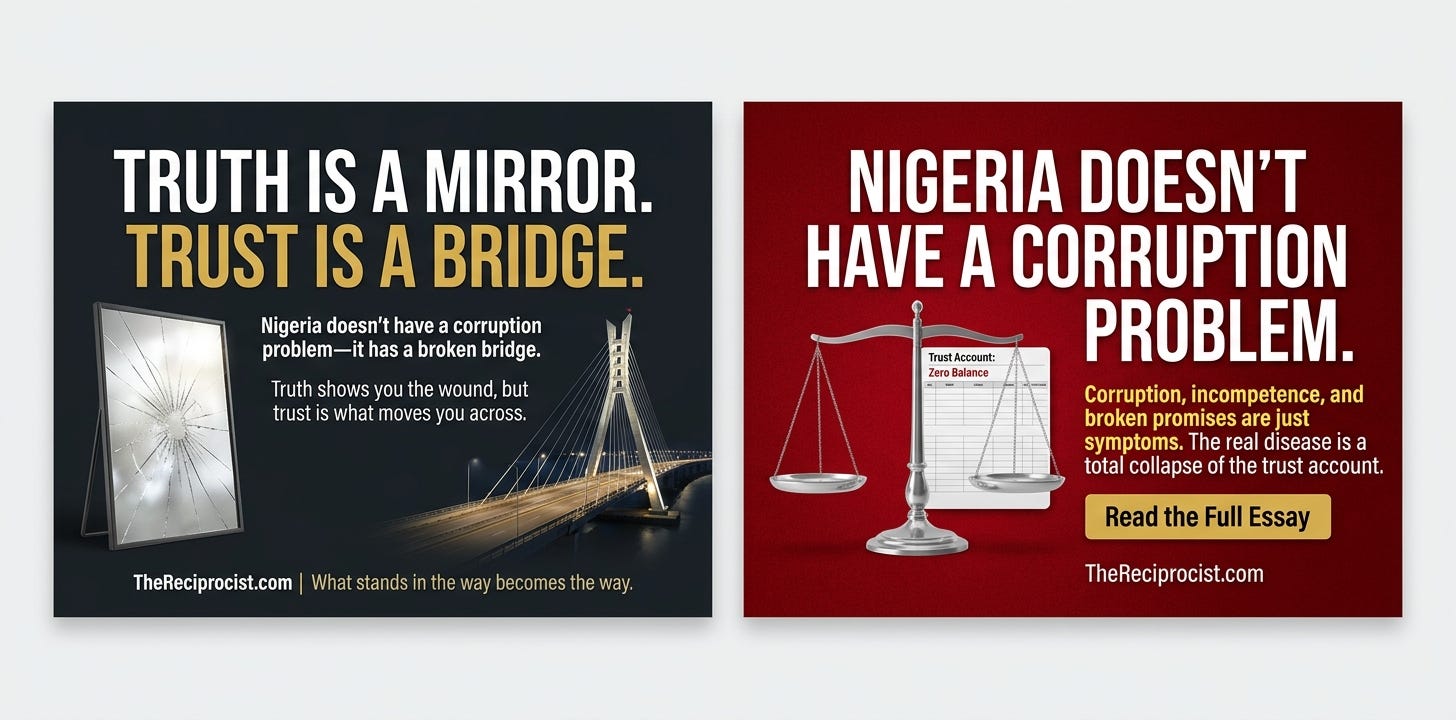
Truth is a mirror. Trust is a bridge.
And bridges matter more than mirrors when the goal is forward motion.
NIGERIA’S REAL DEFICIT
For decades, Nigeria’s problems have been diagnosed a hundred different ways: corruption, incompetence, weak institutions, bad leadership, the oil curse, the colonial hangover. Every election cycle produces a new list of villains — the politicians, the military, the oil companies, the ethnic cabals.
All of it is true. None of it is the disease.
Nigeria does not have a corruption problem. It has a trust problem.
Corruption is a symptom. Incompetence is a symptom. Abandoned projects, failing hospitals, crumbling roads, broken promises — symptoms, all of them. The disease underneath is simpler and harder to fix: Nigerians do not trust their leaders, and Nigeria’s leaders do not trust Nigerians. That distrust isn’t paranoia. It’s a rational response to a long track record.
WHAT TRUST ACTUALLY IS
Trust is not a feeling. It is not optimism. It is not hope.
Trust is the invisible contract that lets two or more minds synchronize long enough to build something larger than themselves. It is the psychological safety required for action — the quiet confidence that the other party will do what they said, not because they’re being watched, but because their word means something.
Progress is a choreography of trust. Every leap, every risk, every collaboration is a vote of confidence in someone else’s reliability.
Comfort is personal. Progress is relational. And relationships collapse without trust.
So the question is never “What is true?” The question that determines whether anything grows is: “Who can I trust enough to move with?”
Truth may illuminate the path. Trust is what gets you across it.
THE TRUST DEFICIT, NAMED PLAINLY
The people don’t trust the government. Ask most Nigerians whether they believe a federal promise will be delivered, and watch the reaction — the laugh, the shrug, the eyes to the ceiling. That’s not cynicism for sport. It’s a learned response, built one incident at a time: a road commissioned with fanfare that’s still unfinished a decade later; a refinery “revived” every election cycle that never quite refines anything; a budget passed whose line items seem to evaporate before they reach the ground; an official caught in scandal who resurfaces in a new post before the story is even forgotten. Every one of these is a withdrawal from a trust account, and after enough withdrawals, people stop depositing. They stop expecting delivery and start expecting disappointment — and they’re rarely wrong to.
The government doesn’t trust the people either. The distrust runs both ways. When budgets stay opaque, procurement stays hidden, and official statistics get disputed as often as they get cited, that’s not incompetence — it’s a government that hasn’t decided to trust its own citizens with the truth about how it’s run. When dissent gets treated as a threat rather than feedback, when journalists and whistleblowers face more scrutiny than the people they expose, the message lands clearly: citizens are something to be managed, not partners to be leveled with. A government that doesn’t trust its people can control them. It cannot lead them — and control is the opposite of progress.
Institutions don’t trust each other. The deficit isn’t only vertical. It runs sideways too — between the arms of government that are supposed to check and complete each other. Agencies hoard data instead of sharing it. A project approved under one administration gets abandoned under the next, not because it stopped making sense, but because it belongs to “the other side.” Coordination that should be routine becomes a negotiation. A house divided against itself doesn’t just move slowly — eventually, it stops moving at all.
WHAT DISTRUST ACTUALLY COSTS
A trust deficit doesn’t show up as a single crisis. It shows up as behavior — millions of small, rational decisions made by people who’ve learned not to rely on promises.
When trust exists, transactions move fast. Contracts get honored without a lawyer in the room. Coordination is cheap, because you believe the other party will do their part. When trust is absent, everything gets expensive: you verify everything, monitor everyone, write contracts that anticipate betrayal, and budget for the lawsuits before you’ve even signed. That friction is why projects that should take two years take ten, why investors route around a market with real upside in favor of one with less potential but more predictability, why so much talent leaves rather than waits, and why cash and informal deals persist — because the formal system hasn’t earned the confidence that would make paper trails feel safe.
It isn’t fear holding a country back. It’s memory.
WHY TRUTH ALONE CAN’T FIX THIS
There’s a comforting theory — especially among journalists, activists, and critics — that exposure is the cure. Publish the numbers. Air the investigation. Name the names. Surely, once the truth is undeniable, things change.
But truth doesn’t move people. Trust does.
Nigeria’s corruption has been exposed more times than anyone can count — in books, investigations, committee reports, whistleblower accounts. And still, the pattern holds, because truth is a mirror. A mirror can show you the wound. It can’t give you the medicine. What actually moves people is trust: trust in a leader who kept his word once and might again, trust in an institution that delivered before, trust in a process that’s stayed consistent long enough to bet on.
A leader can hold the most honest press conference of their career, and it will change nothing if the public isn’t questioning whether the words are true — they’re questioning whether the person saying them can be relied on to still mean it in six months. Truth-telling proves you can see clearly. Trust is proven by what happens after.
HOW TRUST ACTUALLY GETS BUILT
Trust isn’t built with speeches, billboards, or hashtags. It’s built the way a savings account is built — through repeated, small, consistent acts of reliability over time. Every kept promise is a deposit. Every broken one is a withdrawal. The balance grows slowly and disappears instantly.
Trust gets built when a budget is published in plain language and the money can actually be traced. When a project finishes on time, at cost, and someone answers for it when it doesn’t. When a public servant is promoted for performance rather than proximity to power. When a contractor gets paid on schedule, so her own workers do too. When an official refuses a bribe and gets protected for it instead of quietly moved somewhere less inconvenient. Trust gets built when honesty is cheaper than dishonesty, when reliability is rewarded, and when predictability actually pays.
WHAT IT WOULD TAKE
None of this is mysterious. It’s just unglamorous.
Nigeria needs continuity as a principle — institutions, policies, and projects that survive a change of leadership instead of getting erased by it, because a nation that restarts its future every election cycle doesn’t have a future, it has a treadmill. It needs transparency as the default rather than the exception — public dashboards for major projects, budgets a citizen can actually trace, because people cannot trust what they cannot see. It needs betrayal to cost something real — meaningful consequences for the people who break the public’s trust, not a short embarrassment followed by a return to relevance. It needs competence placed above connection, so the person who can actually do the job is the one who gets it. And it needs leaders who are genuinely accountable to the people who empowered them — through elections that are credible, courts that are independent, and a press that’s actually free to ask the next question.
None of it cuts a ribbon. None of it headlines a campaign. But it’s the difference between a country people build their lives inside of, and one they quietly plan their exit from.
A CHALLENGE TO NIGERIA’S LEADERS
You have spent years spending trust you never earned.
You asked the people to sacrifice, to wait, to hope — and gave back mostly promises. You treated trust like a resource to extract, not a treasure to protect, and now the account is close to empty. You are not owed belief. You have to earn it back, the same slow way it was lost.
So here’s the challenge: stop asking for trust, and start earning it. Stop asking people to believe you, and start proving you’re worth believing. Trade the groundbreaking ceremony for the completion certificate. Trade the speech for the receipt. Stop blaming the last administration and start building something the next one can’t erase.
You want to be trusted? Be reliable. History won’t remember the rhetoric. It will remember whether the lights came on, the roads got built, and the promises got kept.
A CHALLENGE TO EVERY NIGERIAN
But trust was never only a leadership problem. It’s a national one.
Do you trust your neighbor — or only your own tribe, your own church, your own circle? Nigeria’s trust deficit doesn’t only live in the seat of government. It lives in the market, the office, the street, wherever one Nigerian decides in advance that another one can’t be relied on.
So here’s the other challenge, and it doesn’t wait for anyone in power to act first: keep your word. Show up on time. Do the job right even when no one’s checking. Refuse the bribe, and refuse to cut the corner. Trust is contagious in both directions — when one person keeps a promise, it gets a little easier for the next person to keep theirs.
THE CHOICE IN FRONT OF US
Nigeria’s problem was never a lack of truth. We already know what’s broken. We already know who failed, and how.
Knowing hasn’t been enough to move us — because truth is a mirror, and a mirror can’t carry you across a river. Trust is the bridge.
The question isn’t “what is true about Nigeria?” It’s “who can we trust enough to move with?”
Truth may illuminate the path. Trust is what gets us across it.
Nigeria is waiting on the other side.
Subscribe and follow if this made you think differently — that’s usually the sign it was worth writing.
OJI — TheReciprocist
what stands in the way becomes the way.