


Societies do not evolve through comfort.
They evolve through confrontation.
Every institution that benefits from injustice eventually gives that injustice a respectable name.
It calls it tradition.
It calls it culture.
It calls it respect.
It calls it stability.
It calls it national unity.
But history has always revealed the truth: these words often become the camouflage of systems that refuse to change.
It takes one person—one inconvenient voice—to expose the lie.
A dissenter does not create injustice.
A dissenter merely refuses to cooperate with it.
That is why dissent is not simply one opinion among many.
It is the mechanism by which every healthy society corrects itself.
Without dissent, injustice becomes policy.
Without dissent, corruption becomes culture.
Without dissent, oppression becomes normal.
Every major leap in human civilization began with someone willing to become unpopular.
Slavery did not end because slave owners suddenly discovered compassion.
It ended because a small, ridiculed minority refused to stop confronting an economy, a political system, and even religious institutions that declared slavery natural. They were mocked as radicals, troublemakers, and enemies of the nation.
History remembers them simply as right.
Apartheid did not collapse because those who benefited from it voluntarily surrendered power.
It collapsed because generations of ordinary and extraordinary people made injustice impossible to ignore. In prisons. In exile. In churches. In classrooms. In the streets.
Power never corrects itself.
It is corrected by people who refuse to accept its abuses.
That has always been true.
It remains true today.
Africa’s Greatest Tragedy
Africa is not poor because it lacks intelligence.
Africa is not stagnant because it lacks resources.
Africa is not behind because it lacks ideas.
Our continent has brilliant minds, abundant natural wealth, resilient people, and one of the youngest populations on Earth.
Our tragedy is different.
We have not built a culture of sustained, principled dissent.
We protest for a week.
We trend on social media for three days.
We organize marches.
We write angry editorials.
Then life resumes.
The system has learned our rhythm.
It knows that if it survives today’s outrage, tomorrow’s silence will protect it.
Corrupt governments do not merely survive because they are powerful.
They survive because they understand that public anger is often temporary.
Our outrage expires long before their determination to preserve power.
The Diversion That Keeps Us Divided
But there is an even deeper tragedy.
In many African societies, dissent rarely remains about principles.
It is quickly transformed into something else.
It becomes tribal.
A citizen exposes corruption.
Before anyone asks whether the evidence is true, someone asks:
“Which tribe is he from?”
A journalist uncovers theft.
Instead of investigating the theft, people investigate the journalist’s ethnicity.
A judge delivers an uncomfortable ruling.
Instead of debating the law, politicians debate the judge’s surname.
A whistleblower risks everything.
Instead of protecting courage, society demands to know whose interests are being served.
Truth is no longer evaluated on its merits.
It is weighed against identity.
The conversation moves from justice to loyalty.
From facts to ancestry.
From evidence to ethnicity.
That is how corruption survives.
Not because it is invisible.
But because it is constantly redirected.
Every criticism becomes a tribal attack.
Every investigation becomes political persecution.
Every reformer becomes “one of them.”
The guilty are no longer defended because they are innocent.
They are defended because they are ours.
This is one of the greatest political tragedies of modern Africa.
We have translated dissent into tribal division.
And once dissent becomes tribal, accountability dies.
Because no institution can survive when identity matters more than integrity.
False Unity
There is a dangerous illusion that has trapped many nations.
Silence is mistaken for peace.
Agreement is mistaken for unity.
Compliance is mistaken for patriotism.
But silence is not unity.
Fear is not unity.
Submission is not unity.
A nation where no one questions authority is not stable.
It is merely quiet.
Real unity is not everyone protecting the same politicians.
Real unity is everyone protecting the same principles.
Justice.
Truth.
Accountability.
Equal treatment under the law.
Everything else is simply organized silence.
The Principles of Consistent Dissent
If Africa is to build stronger institutions, our dissent must become disciplined rather than emotional.
It must become consistent rather than seasonal.
It must become principled rather than tribal.
That means embracing a different civic ethic:
We will never normalize what is abnormal.
We will never accept explanations instead of accountability.
We will criticize actions, not ethnic identities.
We will defend institutions before personalities.
We will demand the same standards regardless of who holds power.
We will remain engaged until meaningful reform is achieved.
Justice cannot depend on who is being accused.
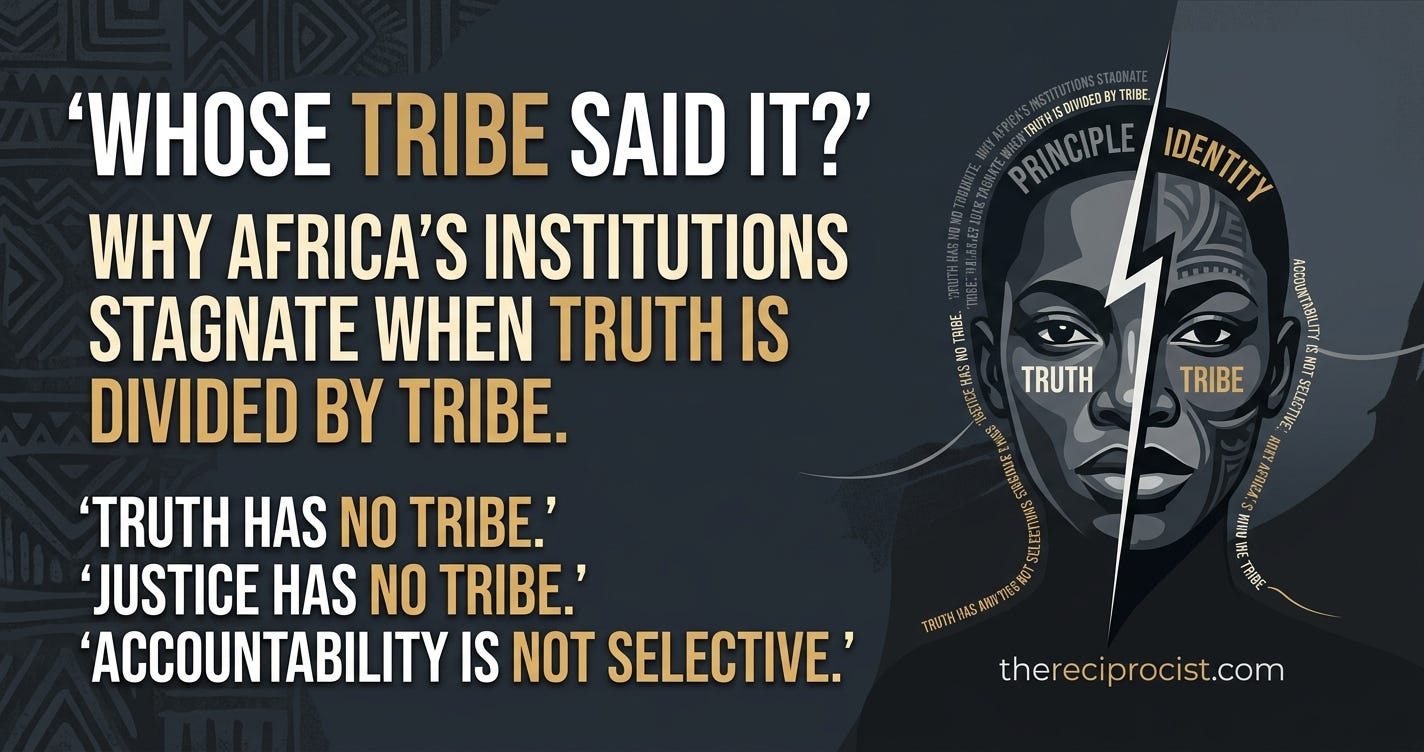
Truth cannot change because a different tribe is speaking.
Accountability cannot be selective.
Otherwise, it is not accountability at all.
My Plea to Africa
I write this not because I love conflict.
I write it because I love Africa.
I am tired of watching brilliant nations held hostage by predictable patterns.
I am tired of seeing every conversation collapse into tribal mathematics.
I am tired of watching honest voices dismissed because of where they were born instead of what they are saying.
I am tired of watching young Africans inherit institutions that reward loyalty over competence and silence over courage.
We cannot continue teaching our children that justice belongs to one tribe while corruption belongs to another.
Corruption has no tribe.
Integrity has no tribe.
Truth has no tribe.
Justice has no tribe.
If we continue filtering every national issue through ethnicity, we will keep producing leaders who understand only one lesson:
Protect your tribe, and your tribe will protect you.
That is not democracy.
That is organized tribal patronage wearing the clothes of government.
Africa deserves better.
The Choice Before Us
Africa does not need fewer people who disagree.
Africa needs more people willing to disagree for the right reasons.
Not because power changed hands.
Not because our tribe lost an election.
Not because our political party was excluded.
But because truth matters.
Because justice matters.
Because institutions matter.
The future of this continent will never be secured by replacing one dominant tribe with another.
It will be secured when every citizen agrees that no tribe, no politician, no party, no president, no traditional ruler, and no institution stands above accountability.
The nations that prosper are not those without dissent.
They are those where dissent is protected, principles are stronger than personalities, institutions are stronger than individuals, and truth is stronger than tribal loyalty.
The greatest enemy of African progress is not disagreement.
It is the moment we stop asking,
“Is this true?”
and begin asking,
“Whose tribe said it?”
The day Africa chooses principle over identity, justice over loyalty, and courage over silence, our institutions will begin to heal.
Because dissent is not the enemy of African unity.
It is the beginning of it.
Subscribe and follow if this made you think differently — that’s usually the sign it was worth writing.
OJI - Thereciprocist